Physics-Informed Deep Learning for Quantitative OCT Reconstruction
Master's Thesis · Quantum Information & Photonics · Universitat Politècnica de València · 2025–2026
Overview
Optical Coherence Tomography (OCT) provides high-resolution, non-invasive imaging of biological tissue. However, extracting quantitative tissue properties from OCT images remains challenging: the measured signal combines tissue reflectivity, optical attenuation and imaging-system blur.
This research explores how physics-informed deep learning can address this coupled inverse problem, moving beyond conventional image reconstruction towards the quantitative recovery of tissue optical properties.
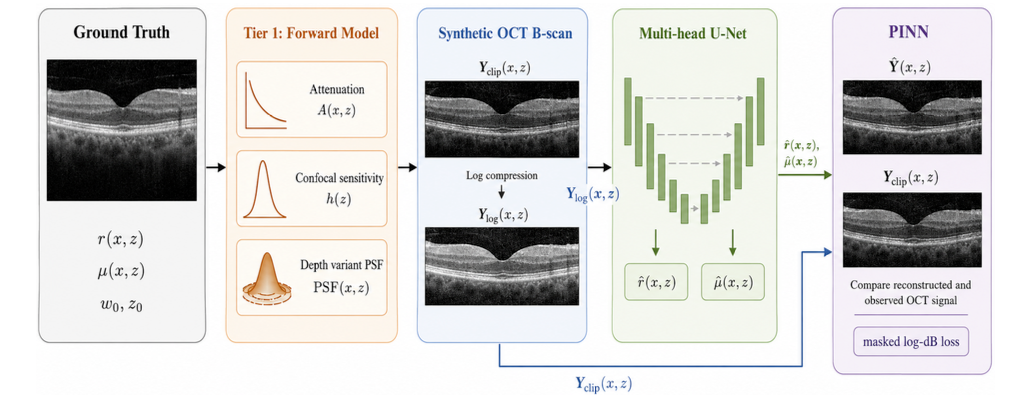
I developed a physics-informed reconstruction framework combining a differentiable OCT forward model with a multi-head U-Net architecture. The network estimates spatial maps of tissue attenuation and reflectivity, while a physics-based reconstruction loss ensures that the predicted properties remain consistent with the observed OCT signal.
Methodology
1. Physics-based OCT modelling
Developed a differentiable forward model based on Beer–Lambert attenuation, confocal sensitivity and depth-dependent Gaussian Point Spread Function (PSF) blur. This model enabled the generation of synthetic retinal B-scans with known underlying optical properties.
2. Deep learning inverse reconstruction
Implemented a multi-head U-Net in JAX/Flax to estimate tissue attenuation and reflectivity maps from synthetic OCT images. The architecture uses specialised decoders to capture the different spatial characteristics of each optical parameter.
3. Physics-informed optimisation
Introduced a reconstruction loss that propagates the network’s predictions through the differentiable OCT forward model. This provides an additional physical constraint beyond conventional supervised learning, encouraging the predicted tissue properties to reproduce the original OCT observation.
4. Electromagnetic simulation and validation
Refined a Finite-Difference Time-Domain (FDTD) electromagnetic simulator using sub-pixel smoothing to reduce numerical staircasing errors. Validated its scattering response against analytical Mie theory, establishing a complementary pathway towards higher-fidelity physical simulations.
Results
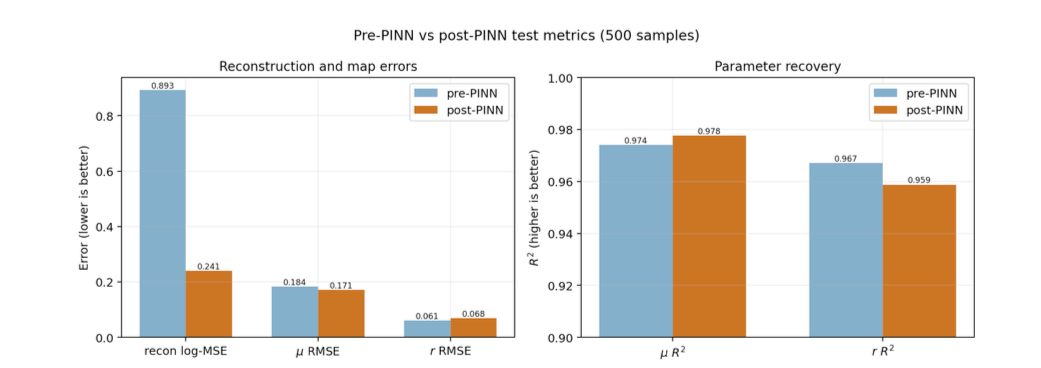
Experiments on 5,000 synthetic retinal B-scans demonstrated that incorporating physical consistency into the learning process substantially improves quantitative reconstruction.
- 3.7× reduction in reconstruction error: Physics-informed fine-tuning reduced reconstruction log-MSE from 0.893 to 0.241.
- High parameter recovery accuracy: Attenuation reached R² = 0.978 and reflectivity R² = 0.959 on the held-out synthetic test set.
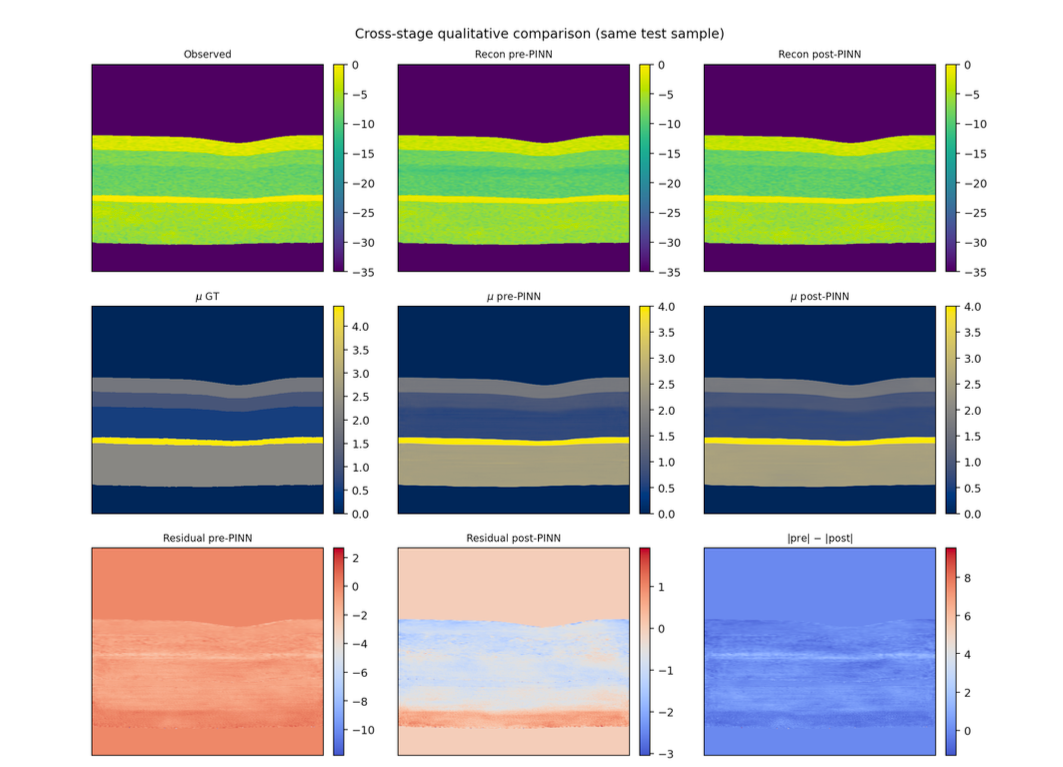
- Improved physical consistency: The reconstructed OCT signal became substantially closer to the original observation while maintaining high tissue-parameter accuracy.
Technical Stack
Python · JAX · Flax · Deep Learning · U-Net · Physics-Informed Neural Networks (PINNs) · Optical Coherence Tomography · FDTD · Mie Scattering · Computational Electromagnetics · GPU Computing
Research Context
Developed within the European SEQUOIA research project, contributing to the development of next-generation optical imaging approaches with improved quantitative precision.